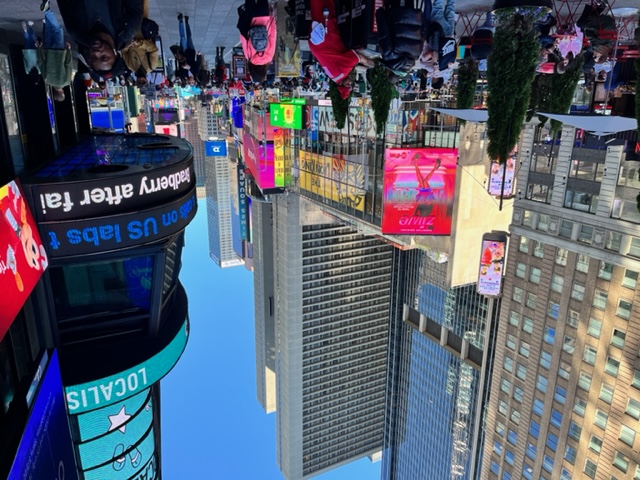
Hello, my name is Eriko Imaizumi (please see my previous article for a more detailed introduction). Starting today, I will be writing a series of articles about my time on Wall Street in America during the 1990s.
At the age of 22, fresh out of university, I joined the Tokyo branch of Merrill Lynch, a foreign securities firm, through my mother’s connections. At the time, very few people joined foreign companies. But I was fascinated by Western culture and secretly dreamed of living in America someday. I think I would have caused nothing but trouble if I had mistakenly joined a Japanese company. Back then, Merrill Lynch was located in the Toranomon Mitsui Building (now Toranomon Daibiru East), next to the Mitsui O.S.K. Lines Building in Toranomon. On the lower floors were American Express and a large rice cracker shop. Merrill occupied two floors, and it was a relatively small office with about 100 employees in total.
I was originally supposed to be hired as a receptionist. However, when I arrived for my first day in April, someone was already sitting at the reception desk. I was told, “Well then, you’ll be an assistant,” and suddenly found myself working as a sales assistant for U.S. equities sold to individual Japanese investors.
The work itself wasn’t particularly busy, but my fellow assistants were amazing. They were all brilliant women who had graduated from universities such as International Christian University (ICU) and Sophia University and spoke fluent English. There were even strikingly beautiful women with well-defined features and a somewhat aloof manner who spoke English better than Japanese, as you might expect at a foreign company. These women were routinely taking not only Japan’s securities sales representative examination but also the English-language securities licensing examination known as the Series 7, which took five hours to complete. Once they passed that, there were plenty of other examinations to choose from, covering interest rates, currency options, futures, and more. It was a workplace where there was no shortage of things to study. I thought it was a great deal to be able to study while working.
I had received an F in high school mathematics. I had no interest in economics or politics. The only things I cared about were fashion, rock music, and my future husband. Yet here I was, able to study for free, and whenever I passed an examination, I could proudly tell everyone, as though showing off a medal, “I passed Series 3, 5, 7, and 15!” Before I knew it, I was completely absorbed in studying. Looking back, this was the beginning of my education in economics and financial markets.
But Black Monday in 1987 was incredible. For about a week, the prices of all kinds of stocks stopped moving. There were simply no prices being quoted. Some people in America even committed suicide, and it was the biggest market crash since 1934. “The world is ending.” “The stock market will never be able to reopen.” “We’re going to lose our jobs.” “The stock market is the root of all evil, ruining people’s lives.” As a 25-year-old young woman who could see only the surface of things, I genuinely believed all of this.
Nevertheless, the market reopened, and although it remained shaky and uncertain, trading gradually returned.
Then, two years later, just as I had already left the company and was preparing to move to America, another major market crash occurred. I still remember talking with a former female colleague and saying, “If something like this happens twice in two years, nobody will ever invest in stocks again.”
And yet, I would go on to spend more than ten years in the very heart of the securities industry, in the world of stocks that I thought nobody would ever invest in again, during an era when the stock market was swept up in extraordinary excitement.
Next time, I will write about what happened after I moved to the United States: my experiences working on Wall Street, a workplace that was both demanding and glamorous. I will share the story of how a young woman who couldn’t understand English managed to survive while surrounded by aggressive American salespeople with prestigious MBA degrees.