What Does It Take to Achieve 10 Times the Results?
What Lies Between 90% and 100%?
I once heard a teaching attributed to a Zen master:
If you put in 50% effort, you will achieve 50% results.
If you put in 90% effort, you will achieve 90% results.
But if you give 100% effort, the result will not be 100%. It will be 1,000%.
Recently, I discussed these words with a group of business leaders who are studying management philosophy.
If you put in 50% effort, you can expect a certain level of results. If you put in 90%, you can expect considerably more.
That much seems understandable.
But why would going from 90% to 100% effort suddenly produce results that are not merely 100%, but 1,000%?
Of course, this is not really about numbers.
So what does it actually mean to give something 100% of your effort?
Perhaps it means thinking about it constantly, from the moment you wake up until you go to sleep.
If you cannot find an answer, you try another approach.
If you fail, you think again.
If the methods you have always relied on no longer work, you become willing to abandon them entirely.
You become so deeply absorbed in one purpose that it occupies your thoughts almost completely.
Perhaps that is what giving 100% really looks like.
But how is that different from giving 90%?
I believe that at 90%, we are still operating within the boundaries of who we have always been.
We work extremely hard, but we do so using our existing knowledge, experience, and familiar ways of thinking.
At 100%, however, those resources are no longer enough.
We reach a point where we think:
“I simply don’t know what else to do.”
Kazuo Inamori once taught:
“When you think you can go no further, that is when the real work begins.”
It is precisely because we reach that point that we begin searching for entirely different ways of thinking.
We ask others for advice. We change our methods. And ultimately, we are forced to change ourselves.
Perhaps that is the fundamental difference between 90% and 100%.
Work as a Path to Personal Growth
Kazuo Inamori placed tremendous importance on devoting ourselves wholeheartedly to our work.
But he was not simply advocating working long hours.
He believed in approaching the work before us with complete sincerity and attention.
He spoke of listening to what a product is telling us and continually asking:
“Is this really good enough?”
“Is there a better way?”
And when something was not working:
“Where has this product been hurt?”
By continually asking these questions and searching for improvements, we develop not only our work but also ourselves.
Inamori also emphasized the importance of always being creative in our work.
Progress does not come from mindlessly repeating what we did yesterday.
It comes from continually looking for ways to improve, refine, and innovate, day after day.
A Buddhist monk may cultivate personal growth through Zen meditation, chanting sutras, and other spiritual practices.
But business owners and leaders rarely have the opportunity to spend hours each day in meditation.
Inamori taught that work itself can become a form of spiritual discipline and self-cultivation.
By dedicating ourselves wholeheartedly to our work, we can develop ourselves as human beings.
We face difficult problems rather than running away from them.
We encounter obstacles, think deeply, and find ways to overcome them.
Through these experiences, our capacity gradually expands.
Problems that once seemed impossible to solve become manageable.
We begin to see familiar situations from a higher and broader perspective.
Through our work, we grow into a more capable version of ourselves.
But Even 100% Effort Cannot Produce 1,000% Results Alone
Still, is personal growth and determination enough to achieve results ten times greater than expected?
I believe another force is needed.
In Japanese Buddhist thought, there is a concept called tariki (他力), often translated as “other-power.”
At first, this may sound like simply relying on other people.
But that is not what I mean here.
Imagine that you have done absolutely everything within your power.
You have committed yourself fully to a goal.
Someone notices your dedication and says:
“Then let me help you.”
Another person introduces you to someone who can open a new door.
Unexpected information comes your way.
Because you have been thinking so deeply about the problem, you suddenly recognize an idea that could fundamentally change your entire approach.
And sometimes, an opportunity appears at precisely the right moment.
You find yourself wondering:
“Why now, of all times?”
There are moments when it almost feels as though the universe itself has come to your aid.
Of course, we could simply call these events coincidences.
But perhaps there is another way to understand them.
An opportunity that would have been invisible to us when we were giving 90% effort may suddenly become recognizable after we have committed ourselves completely.
Our thinking has changed.
Our awareness has expanded.
We are prepared to recognize possibilities we previously overlooked.
And when our own efforts are multiplied by the contributions of others, changing circumstances, unexpected opportunities, and new ideas, something extraordinary can happen.
Our 100% effort begins to produce results far beyond what we could have achieved alone.
Perhaps this is what the Zen master’s teaching about 1,000% results was really trying to convey.
The Most Important Question: Who Are We Giving 100% For?
Today, August 24, marks exactly four years since the passing of Kazuo Inamori.
In an interview during his later years, he was asked what mattered most in life.
His first answer was:
“To live sincerely and wholeheartedly, regardless of the circumstances you find yourself in.”
He went on to explain another essential principle.
Rather than living only with the desire to improve our own circumstances, we should cultivate an altruistic spirit—a genuine desire to bring happiness to others.
When I reflect on these teachings, I begin to think that achieving extraordinary results requires more than simply working harder than everyone else.
We must also ask ourselves:
Why am I working so hard?
Who do I hope to make happy through this work?
Is it for our customers?
For our employees?
To make our company a better place to work?
To contribute something meaningful to society?
When our purpose extends beyond our own personal interests, we may discover a deeper source of strength.
And something remarkable happens.
Other people begin to want to contribute to that purpose as well.
Perhaps this is the final piece that transforms 100% effort into 1,000% results.
What Does Your 100% Really Mean?
Think about one important project or responsibility you are working on right now.
Are you giving it 90% of your effort?
Or have you truly reached 100%?
And there is one more question.
Who are you hoping to make happy through that 100% effort?
Is it simply for your own recognition and success?
Or is there a greater purpose behind what you are doing?
Perhaps when we discover the answer, we begin to see possibilities that were previously hidden from us.
And gradually, an entirely new landscape begins to come into view.
References: Kazuo Inamori Official Website; WEB Chichi (Chichi Publishing)
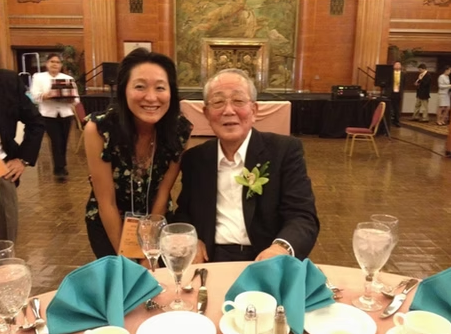
Photo: At the 2012 Los Angeles Seiwajyuku meeting with Kazuo Inamori.